 Polski
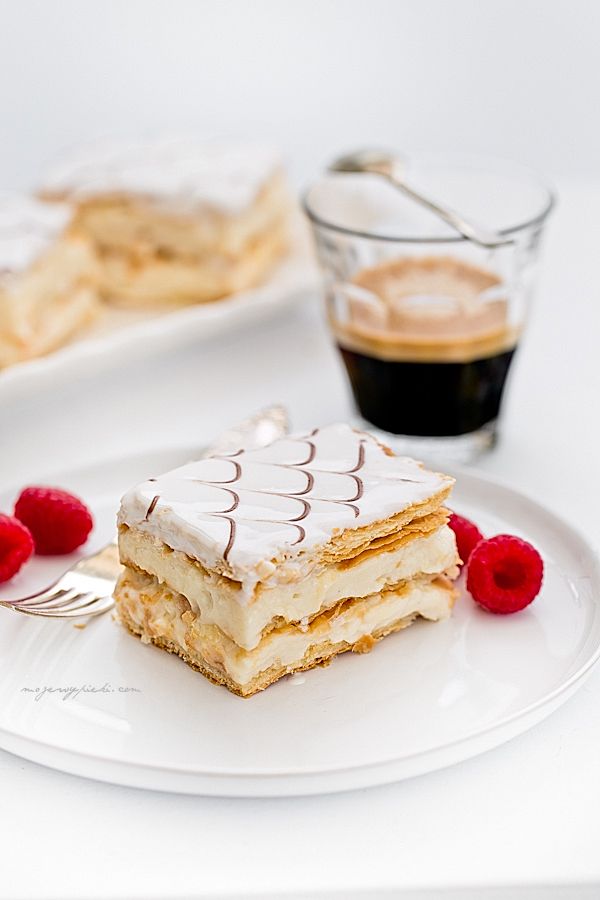
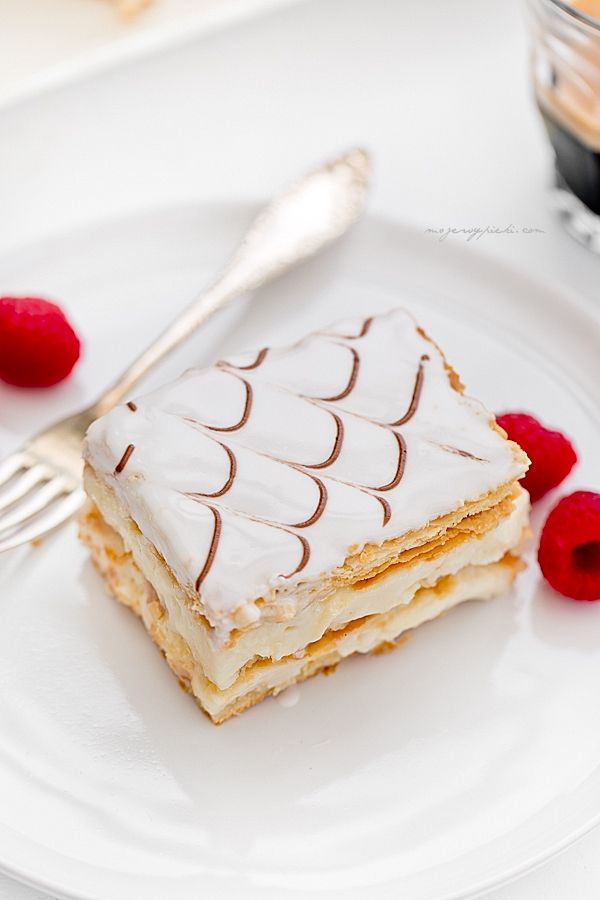
Millefeuille, meaning “a thousand leaves”, is a classic French pastry made with three layers of crisp, flaky puff pastry sandwiched between layers of vanilla pastry cream (crème pâtissière). Some versions use whipped cream and fruit instead. Traditionally, the top is either dusted with icing sugar or covered with icing decorated with fine chocolate stripes. Such simple ingredients, yet such an impressive dessert!
I have to admit, I’m a big fan of pastries like this! Anything with layers of flaky pastry and creamy custard is hard for me to resist ;). Millefeuille also brings to mind the Polish kremówka and napoleonka, and similar pastries can be found in many countries, each with its own name. After all, you can’t go wrong with crisp puff pastry and silky cream! I think millefeuille is best served chilled, when the custard is lovely and cold but the pastry is still crisp and flaky.
If you’re short on time, there’s an easier version you can try: simply bake two sheets of puff pastry and sandwich them with pastry cream. It may not be a traditional millefeuille, but it’s a much quicker way to enjoy the same delicious combination – perfect for when you fancy a treat without too much effort! 😉
Makes 6 servings.
Ingredients for the pastry:
- about 500 g all-butter puff pastry (you’ll need to buy 2 sheets, each weighing about 300 g, and trim them after baking); frozen pastry can also be used
Line a large, flat baking tray with baking paper. Place one sheet of puff pastry on it (if using frozen pastry, thaw it first). Leave the pastry to come to room temperature, as this will help prevent it from shrinking too much during baking.
Dust the pastry generously with plain flour and cover with another sheet of baking paper. Place a larger baking tin on top to weigh the pastry down and prevent it from rising too much. If the tin is lightweight, you can add another tin on top to provide extra weight.
Bake at 200°C for about 15 minutes. Carefully remove the weight and the top sheet of baking paper, then bake for another 5 minutes, until the pastry is golden and lightly browned. Remove from the oven and leave to cool. Bake the second sheet of puff pastry in the same way.
Once cooled, trim the pastry sheets with a pizza cutter to 18 × 24 cm rectangles. Cut each rectangle into three equal strips to make six rectangles measuring 6 × 24 cm in total.
Ingredients for the pastry cream (crème pâtissière):
- 600 ml milk
- seeds from 1 vanilla pod or 1 tsp vanilla bean paste
- 6 egg yolks
- 100 g sugar
- 40 g plain flour
- 40 g potato starch
Pour the milk into a large saucepan and add the vanilla seeds. Bring to the boil, then immediately remove from the heat.
Place the egg yolks and sugar in the bowl of a stand mixer and whisk until pale and fluffy. Add the plain flour and potato starch, then mix until you have a smooth paste with no lumps. Pour in about 100 ml of the hot milk and mix until combined. Pour this tempered egg mixture into the saucepan with the remaining milk. Stir thoroughly, place over a medium heat and cook, stirring frequently, until the cream begins to boil. From this point, cook for about 3 minutes, stirring constantly, until the cream thickens considerably.
Remove from the heat and cover with cling film pressed directly onto the surface of the cream. Leave to cool completely without stirring.
The prepared pastry cream can be stored in the fridge for up to 3 days.
Ingredients for the icing:
- 1 small egg white (30 g)*
- 150 g icing sugar
- 1 tsp lemon juice
- 1 tsp cocoa powder
Make the royal icing by mixing the egg white together with the sifted icing sugar and lemon juice. The icing should be thick but spreadable. Set aside 1–2 tablespoons of the icing and mix with the cocoa powder.
To assemble:
Transfer the pastry cream to a piping bag fitted with a round nozzle about 1 cm in diameter. Alternatively, simply snip the end of the piping bag to create an opening of the same width.
Set aside the two neatest of the six pastry rectangles; these will form the top layer of the millefeuille. Arrange two rectangles measuring 6 × 24 cm side by side in a baking tin. Pipe half of the pastry cream over them and spread it evenly. Cut the remaining four pastry rectangles into smaller pieces measuring 6 × 8 cm using a pizza cutter. It’s best to do this before placing them on the cream, as cutting the assembled pastries later can cause the cream to squeeze out at the sides, unless you have an electric knife.
Arrange the cut pieces of pastry over the cream. Spread the remaining pastry cream on top, then finish with the two reserved rectangles, also cut into pieces measuring 6 × 8 cm. Refrigerate for about 3 hours to allow the cream to chill thoroughly.
After this time, prepare the icing and spread it over the top of the pastries, smoothing the surface. Transfer the cocoa icing to a piping bag fitted with a very fine nozzle (or snip off just the very tip of the bag). Quickly pipe thin, diagonal lines of cocoa icing across the white icing. Using a cocktail stick or wooden skewer, drag through the lines alternately in opposite directions to create the characteristic decorative pattern.
Store the millefeuille in the fridge. It’s best eaten on the day it’s made, while the puff pastry is still perfectly crisp. By the following day, the pastry layers will start to soften as they absorb moisture from the cream.
The egg-white icing can be replaced with a simple water icing. Just mix 1 cup of icing sugar with 233 tablespoons of lemon juice until smooth. Mix a little cocoa powder into a small portion of the icing and use it to create the decorative pattern as described above.
Enjoy!

I read all comments, but unfortunately I can't answer them all. Before posting a question, make sure nobody has asked a similar one (this will be facilitated by the search engine included in the comments). Comments with links may not be published.
Blog author